HOT LINE: +86-510-80628100HOT LINE: +86-510-80628100
The supporting roller is usually a large solid shaft forging. For this type of forging, upsetting and pulling are important forging processes, which play a decisive role in eliminating or weakening the original internal defects of the steel ingot and ensuring the quality of the supporting roller core. The larger the steel ingot, the more severe the metallurgical defects such as looseness, holes, and inclusions in the core, and the greater the difficulty of compacting the core. Ultra large support roller forgings are prone to ultrasonic testing failure due to incomplete forging and compaction of the core. This time, the composite forging main deformation process of "upsetting WHF method for elongation+upsetting FM method for elongation" is adopted to achieve forging looseness and porosity, improve stress and inclusion distribution in the core of the steel ingot, and prevent the formation of new crack sources.
Main technical information of forgings
The specification of the supporting roller forging is φ 2330 mm × 4260 mm × 9400 mm, the material is 45Cr4NiMoV, the forging weight is 196.1 t, and it is produced by forging 300 t steel ingots.
Process plan
FM method refers to the center free tensile stress forging method. Its characteristic is the asymmetric forging deformation of the upper flat anvil and lower platform. During elongation, the billet undergoes asymmetric deformation, resulting in a compressive stress state in the middle of the billet while the tensile stress position shifts downwards. At this time, the areas with more defects in the core of the steel ingot will avoid the destructive effect of tensile stress, resulting in a good forging effect. When using the FM method for elongation, when the anvil width ratio W/H is greater than 0.3, the core of the billet can be subjected to triaxial compressive stress, eliminating the Mannesmann effect. Therefore, a relatively small anvil width ratio can be used to achieve core compaction of ultra large steel ingots. At the same time, the tensile stress at the center of the original forging will shift downwards, and the stress state at 1/2 thickness of the billet is roughly equivalent to that at 1/4 thickness when using the ordinary forging method with an anvil width ratio of 1/2. When the FM method is used for elongation, due to the downward movement of tensile stress, the center position under the hammer is all in a compressive stress state, which can better compact the metallurgical defects in the welded steel ingot center.
The new compaction process scheme adopts a composite main deformation process of upsetting WHF method for elongation and upsetting FM method for elongation. The process parameters of FM method elongation are controlled as follows: after the second upsetting of the steel ingot, 8 rounds of FM method elongation are carried out, and the pressing amount is controlled in a gradient of 16% to 20%. The material width ratio is reasonably controlled by flipping it in 90 ° order, and the effective width to anvil ratio is between 0.42 and 0.65.
Process flow
EBT electric furnace initial refining → LF furnace refining → VD vacuum degassing → VC vacuum casting → steel ingot hot delivery → steel ingot forging → post forging heat treatment → rough machining → ultrasonic testing.
Trial production
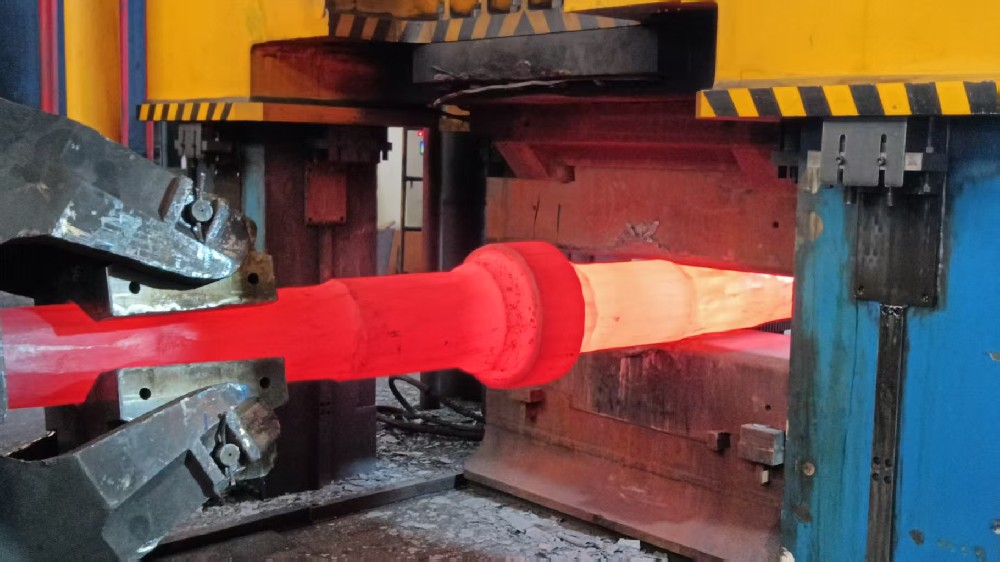
The forging process is produced according to the new main deformation process scheme of "upsetting WHF method for elongation+upsetting FM method for elongation" composite forging. Especially during the two forging main deformation processes, production process supervision is strengthened to ensure that all process parameters are executed properly.
The forging production process is as follows: I Heating by fire - pre-elongation of steel ingots → II Heating by fire - Pressure water, clamps at both ends of the riser → III Heating by fire - one-time upsetting+WHF method for elongation → IV Heating by fire - two upsetting steps+FM method for elongation → V Heating by fire - Pull out the pre card holder → VI Heating by fire - forging finished product → post- forging heat treatment → blank inspection.
Finally, the finished product was fired, with reserved forging ratio and reasonable control of heating temperature. The air cooling and normalizing processes after forging were strictly carried out according to the process requirements, and the forging production of the large support roller was successfully completed.
Conclusion
After the production verification of this batch of large support roller forgings, the following practical conclusions have been formed:
(1) The composite compaction process of "upsetting WHF method for elongation+upsetting FM method for elongation" can achieve good core compaction effect in the production of ultra large solid forgings, and this process has good operability and feasibility in actual production.
(2) When formulating the compaction plan for oversized solid forgings, the influence of the actual effective anvil width ratio on the compaction effect should be considered.
(3) Through this process research and production practice, the forging methods have been enriched and the production experience of ultra large solid forgings has been accumulated.